Is a More Expensive Gift Always Better for Dad?
Every year around Father’s Day, the same quiet panic sets in: Dad says he doesn’t need anything, and somehow that makes the gift harder to choose, not easier. There’s a nagging feeling that if you don’t spend enough, the gift will look like you didn’t try. So the price tag creeps up, not because the gift got more thoughtful, but because a higher number feels safer.

Here’s the direct answer: no, a more expensive gift is not automatically a better gift for Dad. Price measures what something costs. Personal value measures what the gift means once it becomes part of Dad’s actual life. A $200 gadget he never plugs in is not a better gift than a $20 mug tied to a memory he still brings up at dinner. This guide covers how to think about inexpensive gifts for dad, including a simple way to compare gift value and a budget breakdown so you can stop guessing. The better question isn’t how much you should spend. It’s what the extra money actually buys.
Is a More Expensive Gift Actually Better for Dad?
Short answer: No. A gift’s price and personal value are two different things, and recent Father’s Day survey data supports this. Shoppers rank finding something unique and creating a memory above cost as buying priorities, which suggests price is not the leading factor in what makes a gift land well.
Price and Personal Value Are Not the Same Thing

Price is a number on a receipt. Personal value is what the gift means once it becomes part of Dad’s everyday routine, whether that’s a mug on his desk or a hat he wears every weekend. A luxury watch can be objectively expensive and still fall flat if Dad has never worn a watch in his life. Meanwhile, a $15 tumbler with the kids’ handprints etched into it can become the thing he brings up a year later, unprompted.
National survey data doesn’t prove that a cheaper gift is automatically a better one, but it does show what shoppers say they’re actually optimizing for. A May 2026 survey of 7,914 U.S. adults, conducted by Prosper Insights & Analytics in cooperation with the National Retail Federation, found that 44.1% of Father’s Day shoppers prioritized finding a gift that was unique or different, and 34.3% prioritized creating a special memory. Only 21.8% cited cost-effectiveness as a primary consideration. Cost-effectiveness ranked well below both uniqueness and memory-making among the listed gift-purchasing priorities.
A higher price only creates more gift value when it improves something Dad will actually notice: usefulness, quality, durability, or personal meaning. Beyond that, extra spending is mostly just extra spending.
What Makes a Gift Feel Valuable?
Five factors tend to separate a gift that gets used and remembered from one that gets set aside:
Personal relevance. It connects to something specific about him rather than a generic “dad” stereotype.
Emotional meaning. It’s tied to a memory, a relationship, or an inside joke.
Everyday usefulness. He’ll actually reach for it.
Quality and durability. It holds up to real use instead of falling apart in a month.
Evidence of thought and effort. He can tell someone chose it on purpose, not just paid for it.
A gift that checks several of these boxes can be a stronger choice than an expensive item with little connection to Dad’s actual life. This is exactly why the best inexpensive gifts for dad rarely look like the cheapest items on a shelf; they’re chosen with these factors in mind rather than by price alone.
The Gift Value Test
Here’s one way to compare two gifts side by side instead of defaulting to whichever one costs more:
| Factor | Weight | Question to ask |
|---|---|---|
| Usefulness | 30% | Will Dad actually use it? |
| Personal relevance | 25% | Does it fit his interests or routine? |
| Emotional meaning | 20% | Does it connect to a shared memory? |
| Quality | 15% | Will it hold up over time? |
| Price | 10% | Does the cost fit your budget comfortably? |
This isn’t a scientific formula, and the exact percentages aren’t the point. It’s a way to stop letting price dominate the comparison by default. Think about two gifts Dad might open on the same Sunday morning: an expensive gadget chosen mainly because it looked impressive online, and a $20 mug printed with the nickname he’s had since childhood. Score them against the table above, and the mug often wins on usefulness, relevance, and meaning even though it loses badly on price. That’s the whole point of weighting price at only 10%: it matters, but it’s rarely what makes a gift memorable.
Is an Inexpensive Gift the Same as a Cheap Gift?
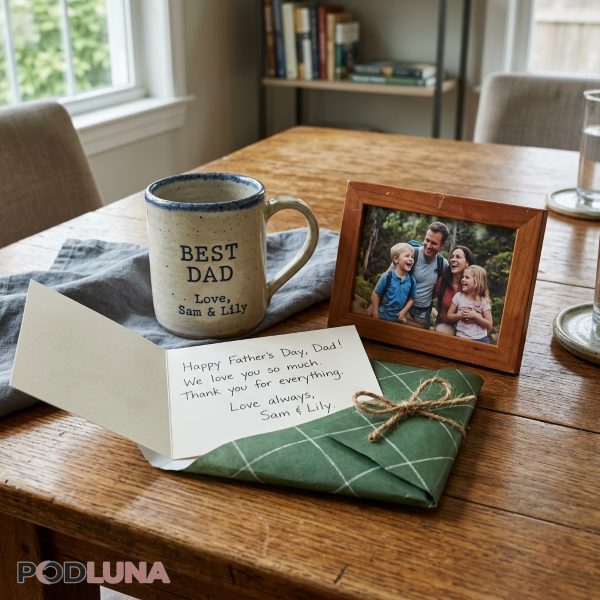
Short answer: No. “Inexpensive” describes price. “Cheap” usually describes perceived quality or a lack of thought behind the choice. A $20 personalized mug can be inexpensive without feeling cheap if it’s well made, genuinely useful, and connected to something Dad actually cares about.
A gift starts to feel cheap when it looks random, disposable, or picked without the recipient in mind, regardless of what it cost. It starts to feel thoughtful when the item is something he’ll use, the design fits his taste rather than a generic template, the personalization has a real connection to him, and the presentation shows some care. A few habits separate the two:
- Choose one well-made item over several low-quality ones
- Keep personalization specific to Dad, not a generic “World’s Best Dad” template
- Match the design to his actual taste, not just what’s trending
- Add a handwritten note, even alongside a small gift
None of these cost extra money. They just require paying attention to him specifically, which is a large part of what turns an inexpensive gift into a meaningful one.
How to Keep a Personalized Gift From Looking Cheap
Personalization can make an inexpensive gift feel thoughtful, but poor execution has the opposite effect. A few things tend to separate a personalized gift that looks intentional from one that looks like an afterthought:
| Check | Why it matters |
|---|---|
| Font and text size | Names or details shouldn’t disappear at normal viewing distance |
| Design restraint | One meaningful detail usually reads better than a design crowded with names, dates, and messages at once |
| Product usability | The item still has to work as something he’ll actually use, not just something to look at |
| Material fit | Apparel, drinkware, and home decor each wear differently, so the material should match how often he’ll use it |
| Personal relevance | The detail should mean something specific to Dad, not just fill a customization field |
A restrained design built around one real detail, like a nickname, a location, or a date that matters, usually reads as more intentional than a product covered edge to edge in text.
Why Thoughtfulness Can Matter More Than the Price Tag
Personalization Turns an Ordinary Gift Into a Personal One
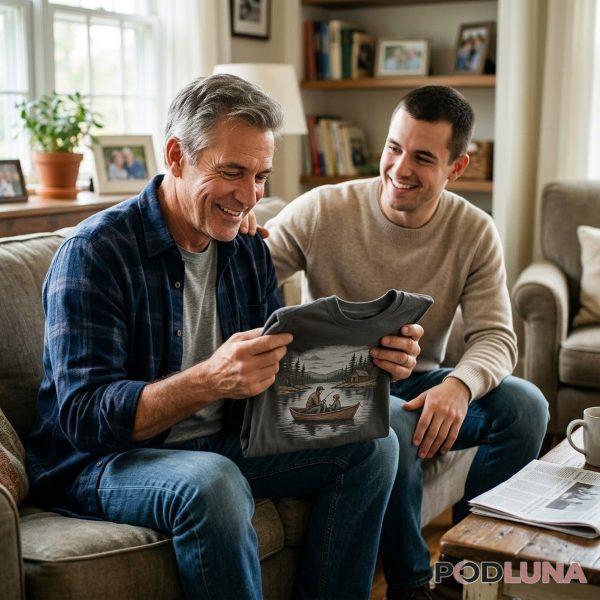
A plain t-shirt is forgettable. A t-shirt referencing the fishing spot he’s taken you to every summer since you were seven is not. The difference is specificity. A generic “Best Dad” message could come from anyone. A reference to your family’s actual fishing trip could only come from you.
Names, family jokes, meaningful dates, a child’s drawing, a shared location: these details are what personalization research points to as adding real value, not just decoration. A study published in the Journal of Consumer Marketing by researchers Marta Pizzetti and Michael Gibbert found that gift recipients value personalized items for two reasons at once. Personalized gifts can feel valuable both because they’re useful and because they communicate something about the giver. The research suggests this expressive quality can add value beyond the product itself, separate from whether the recipient likes the physical item on its own merits.
This doesn’t mean personalization is the right call for every dad. A more private or understated dad might feel put on the spot by an item that broadcasts family sentiment loudly. Personalization is a genuinely researched lever for adding value, not a rule that applies the same way to everyone.
Sentimental Value Can Be Easy for Gift Givers to Underestimate
There’s a documented mismatch in gift-giving behavior worth knowing about. Research published in the Journal of Consumer Psychology by Julian Givi and Jeff Galak found that when people choose between a sentimentally valuable gift and one that simply matches the recipient’s known preferences, they tend to choose the preference-matching option more often than recipients would actually prefer. The study’s authors traced this to uncertainty rather than a lack of care: givers feel confident a preference-matching item will be well received, but they’re less sure how a sentimental gift will land, so they default to the safer option.
If you’ve ever passed over a more meaningful gift idea in favor of a gift card or a generic item, this research offers a plausible explanation. It doesn’t mean the sentimental option would have failed. It means the safer choice simply felt like less of a risk to make.
A Small Gift Can Still Signal Real Effort
A cheaper gift can actually take more effort to choose. You might spend ten minutes checking out with a $150 gadget, or spend an hour tracking down an old photo, remembering a family joke, or figuring out what Dad will actually use. The second gift gives him a reason to tell the story behind it, which is something the gadget usually can’t offer.
How Much Should You Spend on a Gift for Dad?

There is no universal amount you should spend on Dad. A practical starting point is under $25 for a small, thoughtful item, $25 to $50 for a personalized everyday piece, and $50 to $100 when higher quality or a shared experience genuinely adds something.
| Budget | Best Strategy |
|---|---|
| Under $25 | A small personalized item, a handwritten note, a homemade treat, or a simple shared activity |
| $25 to $50 | Personalized apparel or drinkware, a hobby-related item, or a practical everyday upgrade |
| $50 to $100 | A higher-quality upgrade, a small experience, or a coordinated gift set |
| $100 and up | A premium experience or a substantial upgrade, reserved for when it genuinely fits Dad’s life |
Treat these as planning ranges, not rules. The right number depends on your budget and how Dad generally feels about receiving gifts.
Rule of thumb: spend more when the additional cost buys additional usefulness or meaning, not simply additional prestige.
When Spending More Makes Sense
Higher spending tends to be justified when he genuinely needs an upgrade to something he already uses, when the item will be used often enough that better materials pay off over time, when it supports a hobby he’s already invested in, when it marks a real milestone like a retirement or a big birthday, or when the added cost is comfortably within the family’s means.
When Spending More Is Probably Not Worth It
Spending more is harder to justify when it’s driven mainly by the appearance of generosity, when the item is something he’s unlikely to actually use, when it has no real connection to his interests, or when it stretches beyond what feels financially comfortable because of social pressure to “go big.”
A Quick Example: $30 vs. $100
| $30 option | $100 option |
|---|---|
| Personalized mug plus a handwritten note | A generic gadget he didn’t ask for |
| Strong personal connection | Higher price tag |
| Used daily | May or may not get used |
| Comfortable for most budgets | A bigger financial stretch |
| Wins if Dad values meaning over novelty | Wins only if the gadget solves a real need |
Choose the $100 option only if the extra $70 buys something Dad will genuinely use or appreciate. If it doesn’t, the $30 gift usually wins on every measure that actually matters to him.
How to Find Inexpensive Gifts for Dad That Still Feel Meaningful

For shoppers comparing inexpensive gifts for dad, the strongest options usually share one thing in common: they solve a small everyday need while carrying some personal meaning behind them.
Start With What Dad Already Uses
A few questions tend to do more work than browsing a gift guide: What does he drink first thing in the morning? What does he wear most often, even if it’s nothing special? What does he do to unwind after work or on a Saturday? What hobby does he keep returning to, year after year? What object does he reach for without thinking about it?
Start with something Dad already reaches for. If coffee is part of his morning, a personalized mug makes more sense than a novelty gift. If he spends weekends grilling, a small grilling-related gift feels more intentional because it fits something he already enjoys.
Choose a Memory Instead of a Generic Message
“World’s Best Dad” says nothing specific. A gift built around a real memory says more. Consider a family inside joke, a vacation everyone still talks about, the town where the family grew up, a meaningful date, one of the kids’ drawings, or a phrase he repeats so often it’s become a running bit. A specific memory will often feel more personal than a generic sentimental message.
Match the Gift to His Personality
Start with the way Dad actually lives day to day. A practical dad usually responds best to a useful everyday item, while a sentimental dad is more likely to hold onto a personalized keepsake tied to a real memory. A funny dad appreciates humor that’s specific to your family rather than a generic dad joke, and a dad with a strong hobby usually prefers something that improves what he already does over an item meant to introduce a new interest. If Dad hates clutter, skip another physical object: take him to breakfast, plan a round of golf, or give him something he’ll use up. And if he insists he doesn’t need anything, a low-pressure gesture, like a shared afternoon together, tends to land better than a big surprise purchase.
The strongest budget-friendly gifts usually do two things at once: they solve a small everyday need and remind Dad of something personal.
If you’re not sure where to start, browsing a wider range of thoughtful gift ideas for dad can help narrow things down before settling on a specific item.
10 Inexpensive Gifts for Dad That Don’t Feel Cheap

These ideas work because of what each one is connected to, not because of what it costs.
1. A personalized coffee mug for his morning routine. Best for: a dad with a fixed morning coffee habit. Keep it personal: use a nickname, location, or a phrase from a real family memory rather than a stock “Best Dad” design. Avoid: long sentimental messages if Dad tends to prefer understated designs.
2. A custom t-shirt built around his personality. Best for: a dad who has a strong hobby, sports team, or running family joke. Keep it personal: base the design on something specific to him, not a generic “dad” slogan. Avoid: over-designing the shirt with multiple references at once. One detail usually reads better than five.
3. A personalized tumbler for work or the road. If he commutes, travels, or spends time outdoors, a tumbler with his name or a meaningful phrase gets daily use.
4. A small piece of wall art tied to a family memory. A meaningful location, a milestone date, or simple typography referencing something specific tends to work better than a generic “family” print.
5. A handwritten letter paired with something small. This costs almost nothing and often means more than anything you could buy.
6. A homemade meal or his favorite dessert. The value here comes from the time and effort behind it, not from what the meal costs.
7. A shared experience. Breakfast together, an afternoon of fishing, a movie night, a local game, or a family cookout can make the gift part of a memory Dad keeps, not just an object he opens once.
8. A personalized hobby-themed item. Tie the design to something Dad already enjoys, whether that’s a fishing trip, a favorite golf course, a grilling tradition, or a sports memory. The item can be simple; it’s the specific reference that makes it feel like his.
9. A photo or memory-based keepsake. A specific memory tends to feel more personal than a generic sentimental message.
10. A small themed bundle. Coffee, a mug, and a handwritten note. A grilling tool paired with a family recipe. A t-shirt with a card. Bundling a few small, related items often feels more considered than one larger, unrelated purchase.
If Dad is the type who says he already has everything, the challenge usually isn’t budget. It’s finding something he hasn’t already bought for himself. A guide to gifts for dads who have everything can help you think beyond the obvious options.
When Personalized Gifts Are Worth the Extra Thought
Personalization Ideas That Cost Less Than Luxury Gifts
A name or nickname, his role in the family, a meaningful date, a photo, an inside joke, a hobby reference, or a specific location can all turn a modest item into something that reads as personal rather than store-bought.
Personalized Apparel, Drinkware, and Home Decor

These categories tend to work well because Dad will actually use or see them regularly, not display once and forget. Apparel, including t-shirts, hoodies, and casual button-ups, works when the design fits something he’d wear anyway. Drinkware, including mugs and tumblers, fits directly into a routine he already has. Home decor, such as wall art or small decorative pieces tied to a family memory, adds personalization without needing a luxury price point behind it.
When Personalization Can Miss the Mark
Personalization works best when the detail feels natural to Dad’s actual personality and habits. A name printed on a mug simply because the customization field was available doesn’t add much on its own. Neither does a sentimental message that feels out of character for a dad who tends to be private about emotion, or a design that clashes with the style he’d normally choose for himself. Before personalizing anything, it helps to ask a simpler question: would Dad recognize this detail as something that actually belongs to him?
If Dad tends to be private or reserved about how he shows affection, it’s worth thinking through personalized gifts for sentimental dads before choosing a design that might feel like too much for his personality.
How to Make a $20 Gift Feel More Meaningful

Skip “I thought you might like this.” Try something closer to “I picked this because it reminds me of our Saturday morning coffee runs.” Specificity does more work than the item itself, and giving the gift a short story behind it changes how it lands.
Pairing a gift with time together also helps: a mug alongside breakfast, a shirt paired with a family photo, a hobby item followed by an afternoon spent using it together. The gift plus the time spent around it tends to carry more weight than either one on its own. Presentation matters too. A handwritten note, thoughtful wrapping, giving it privately rather than in a crowd, and explaining directly why it reminded you of him can shift how even a modest gift is experienced.
What Should You Avoid When Buying a Budget Gift for Dad?
- Choosing something purely because of its price, high or low
- Picking a generic gift that could belong to any dad
- Buying a duplicate of something he already owns
- Choosing a complicated gadget he’s unlikely to actually use
- Personalizing an item in a way that doesn’t reflect who he is
- Spending beyond your means to create an impression of generosity
- Assuming every dad wants something sentimental, since some genuinely don’t
A useful gut check before buying: will Dad still use, display, remember, or bring up this gift six months from now? If the honest answer is yes, it’s often a stronger choice than something pricier with less relevance to his actual life.
A More Personal Approach to Budget-Friendly Gifting
At Podluna, we focus on personalized apparel, drinkware, and home decor that make everyday gifts feel specific to the person receiving them. For Dad, that can mean a design built around a family memory, a favorite hobby, or an inside joke rather than a generic message. When you’re ready to turn the idea into something tangible, explore the everyday gifts for dad collection.
Which Budget Gift Should You Choose for Dad?
The table below pulls the decision points from this guide into one place:
| If Dad… | Choose… |
|---|---|
| Uses the same things every day | A personalized everyday item, like a mug, tumbler, or piece of apparel |
| Values memories more than objects | A keepsake or family-photo-based gift |
| Dislikes clutter | An experience or something consumable |
| Has a strong hobby | An upgrade tied to that specific hobby |
| Says he doesn’t need anything | A shared experience or low-pressure gesture |
| Communicates through humor | A personalized joke or family-specific reference |
| Your budget is very limited | A small gift paired with a handwritten note or shared time together |
Frequently Asked Questions About Inexpensive Gifts for Dad
Does spending more make a gift more meaningful? Not by itself. Spending more makes sense when the higher price improves something Dad will actually notice, such as quality, durability, usefulness, or the experience itself. Without that connection, extra spending mostly just adds cost.
What is a good inexpensive gift for dad? Something personalized, genuinely useful, and connected to a routine or memory he already has. A mug tied to his morning coffee or a tumbler for his commute tends to hold more weight than an expensive item with no real connection to his life.
What are the best inexpensive gifts for dad under $25? The strongest options under $25 are usually small personalized items, a handwritten note paired with something useful, a favorite snack, a homemade treat, or a simple item tied to Dad’s daily routine. The best choice is the one that feels specific to him rather than simply cheap.
How much should I spend on my dad’s gift? There’s no fixed rule, but the budget framework above (under $25, $25 to $50, $50 to $100, $100 and up) can help match your spending to what actually adds value rather than just cost.
Are cheap gifts for dad still meaningful? Yes, as long as low price doesn’t come with low effort. A gift built around a real memory can carry more weight than a pricier one with no connection to him at all.
Is it better to buy Dad something expensive or personalized? Personalization can add meaning without requiring a higher price, particularly when the design reflects something specific about Dad. Spending more makes more sense when the added cost buys real usefulness, quality, or durability he’ll actually benefit from.
What can I give Dad if he says he wants nothing? A shared experience, a small personalized everyday item, a handwritten note, his favorite meal, or simply time spent together tend to land better than another object he didn’t ask for.
What is a meaningful gift for a dad who has everything? Experiences, family-memory-based keepsakes, personalized everyday items, and genuine upgrades to something he already owns and uses tend to work best here.
The Best Gift for Dad Is the One That Fits His Life

So, is a more expensive gift always better for Dad? No. National survey data suggests shoppers rank finding something unique and memorable above cost when choosing a Father’s Day gift, and research on gift giving suggests recipients often want more thoughtful, sentimental gifts than givers feel confident enough to choose. The best inexpensive gifts for dad are rarely the cheapest ones on a list. They’re the ones that fit his routine, his personality, and your actual budget.
Don’t aim for the lowest price. Aim for the gift Dad is most likely to use, enjoy, or remember, and buy it at a price that doesn’t leave you uncomfortable afterward. Focus on relevance, usefulness, personalization, and the reason behind why you chose something. The goal was never to impress Dad with what you spent. It’s to give him something that makes him feel noticed, appreciated, and understood.
Sources referenced:
- Medill Spiegel Research Center, Northwestern University, and the National Retail Federation / Prosper Insights & Analytics: Father’s Day Spending as Consumers Seek More Meaningful Ways to Celebrate (May 2026 survey, n=7,914)
- Givi, J., & Galak, J. (2017). Sentimental value and gift giving: Givers’ fears of getting it wrong prevents them from getting it right. Journal of Consumer Psychology, 27(4), 473-479.
- Pizzetti, M., & Gibbert, M. (2018). The value of gift personalization: current insights from the gift recipient’s perspective and future research directions. Journal of Consumer Marketing, 35(5), 512-521.