How to Pick a Gift Your Dad Will Actually Use
Shopping for Dad can be oddly difficult, especially when his answer to every gift question is, “I don’t need anything.” Dads tend to stop asking for things a long time before anyone notices, which is exactly why the gift aisle rarely has the answer.
Finding useful gifts for dads doesn’t usually mean discovering something completely new. It means noticing what Dad already reaches for, where his routine has a little friction, and whether a better version of something familiar would make his day easier.
The short version: look at what he already uses every day, find something that’s worn out or mildly inconvenient, then replace, upgrade, or personalize it. Before buying, ask where the gift will actually live in his routine, how often he’ll use it, and whether he’d choose it himself if he saw it in a store. The rest of this guide breaks that process down in detail, including specific guidance for the situations that trip most people up, like a dad who insists he wants nothing.
What Makes a Gift Truly Useful for Dad?
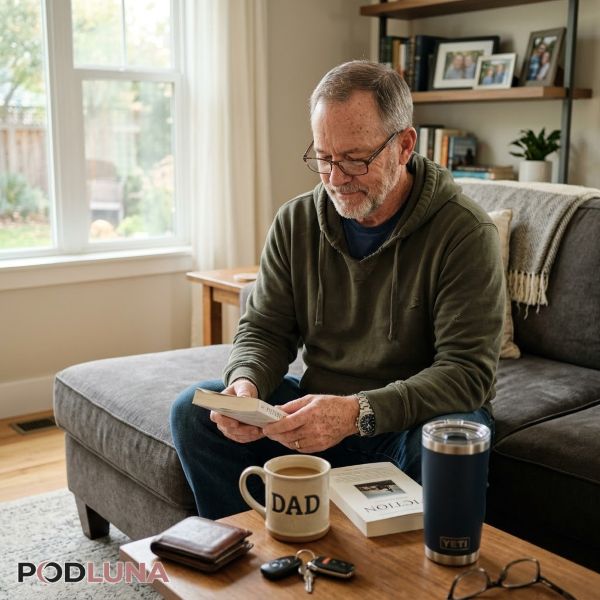
A useful gift for Dad is something he already needs, uses regularly, or would use as part of his existing routine. The strongest choices usually do four things at once: solve a small recurring problem, match his personal preferences, offer reliable everyday function, and add a personal touch without making the item harder to use.
“Useful” gets used loosely in most gift guides to mean anything with a practical shape: a tool, a gadget, a wallet. That’s not quite right. Something becomes genuinely useful when it meets several of those conditions together, not just one. Miss two or three of them, and even a “practical” item ends up in a drawer.
The best useful gifts for dads tend to sit at the intersection of three things: function, familiarity, and personalization. A mug is functional. A mug he already reaches for every morning is familiar. A mug with his initials or a family inside joke on it is personal. Put those qualities together and you get something he’ll actually use, not just something he’ll thank you for and forget.
It also helps to know what “useful” isn’t. A thoughtful gift can be deeply appreciated without ever getting used regularly, like a framed photo or a handwritten card. A novelty gift is fun once and then forgotten. A decorative piece gets looked at, not handled. None of those are wrong choices; they’re just answering a different question than the one this guide is about.
The Gift Utility Score: A Quick Way to Test Any Idea
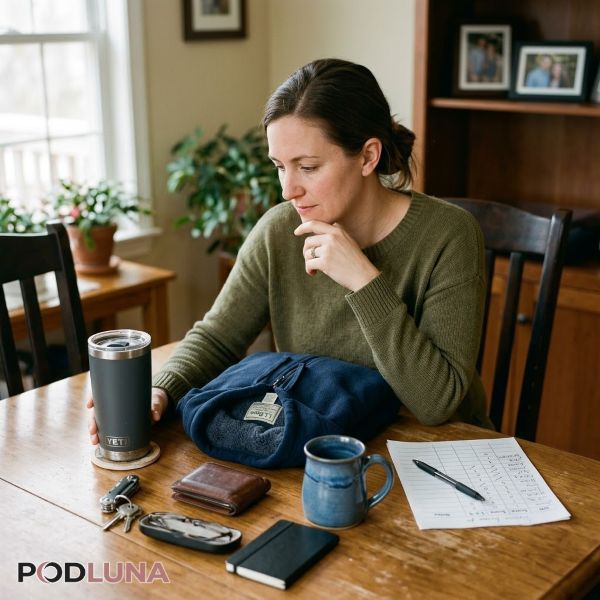
Before committing to a gift, it helps to score it rather than rely on gut feeling alone. Rate the idea from 1 to 5 on each of these five factors, then add them up.
| Factor | Ask yourself | Score (1–5) |
|---|---|---|
| Frequency | Will he realistically use this weekly, or more? | |
| Convenience | Is it easy to use, carry, and maintain, with no learning curve or hassle? | |
| Personal fit | Does it match his taste in size, style, and material? | |
| Problem solved | Does it fix something that actually bothers him? | |
| Personal meaning | Does it feel chosen for him specifically, not just bought? |
Our editorial rule of thumb: 20 to 25 points means the idea is strong enough to consider, 15 to 19 means it needs another look, and anything below 15 is a warning sign. This is an editorial decision tool, not a scientifically validated formula. It’s built around the five reasons a good-looking gift most often ends up unused: low frequency, inconvenient upkeep, a poor fit for his taste, no real need behind it, and a weak connection to him personally.
One practical lesson behind this approach: the safest gift isn’t always the most exciting one. If Dad already carries the same tumbler to work every day, replacing it with a better version tells you far more about what he’ll actually use than guessing at a brand-new hobby or gadget. The closer a gift sits to something already working in his routine, the less you’re asking him to change his habits just to enjoy it.
For a second, faster gut check, run the Six-Month Test. Picture Dad opening the gift again six months from now, and ask three questions: Where would he keep it? When would he actually use it? And what would make him quietly stop using it, a bad fit, an inconvenient design, a lack of a clear spot for it? If you can answer the first two easily and can’t think of an obvious answer to the third, it’s usually a solid idea.
Finding the Right Idea by Watching, Not Guessing

Rather than starting with a product category and working backward, start with what Dad’s life actually looks like day to day. Notice what he uses constantly (his coffee mug, wallet, favorite hoodie, the tool he always keeps within reach), what he uses until it wears out (a T-shirt with a fading logo, a tumbler with a cracked lid), and where a small, specific problem exists (his coffee goes lukewarm, his desk feels sterile). Then match the idea to a part of his day and ask whether he’d genuinely choose it himself.
That combination of observation plus the Gift Utility Score is really the whole method behind finding useful gifts for dads. Here’s how it tends to translate into a direction once you know what to look for:
| What you notice about Dad | Best gift direction | Why it works |
|---|---|---|
| Uses the same item every day | Upgrade it | Familiarity lowers the risk of a miss |
| Uses an item until it’s worn out | Replace it | You already know he’ll use it |
| Seems to have everything | Personalize an everyday item | Adds meaning without adding clutter |
| Commutes daily | Choose something portable | Fits an already-established routine |
| Works from home | Pick a desk or home item | Useful in the space he already occupies |
| Values family memories | A personalized functional item | Combines sentiment with everyday use |
| Dislikes clutter | One high-frequency item | Adds utility without adding volume |
Useful Gift Ideas Based on Dad’s Routine

Thinking about Dad’s daily routine instead of starting with a hobby usually leads to better ideas, and it avoids the trap of assuming every dad is either a “grill guy” or a “golf guy.”
Start with the part of Dad’s day where the gift will naturally fit. If coffee is already a morning ritual, an insulated mug or travel tumbler makes more sense than introducing a new gadget he’d have to learn to use. If he spends most weekdays at a desk, a well-chosen office item tends to get more mileage than something purely decorative. A commuter benefits from anything compact enough to live in his car or work bag, while a dad who spends more time at home tends to get more use from a comfortable hoodie, an everyday T-shirt, drinkware, or a small piece of decor. The label you’d put on him matters less than the routine the gift needs to fit into.
The same logic applies to hobbies. Rather than defaulting to “fishing dad” or “grilling dad” shorthand, look at what he actually does with his time, whether that’s DIY projects, gardening, cooking, reading, tech tinkering, or travel, and ask the same questions: what does he already use for this, what small problem exists within it, and what kind of personalization would actually make sense here.
For a broader library of ideas organized this way, our useful gift ideas for dad guide covers more routine-based categories in detail.
What to Get Dad When He Says He Wants Nothing
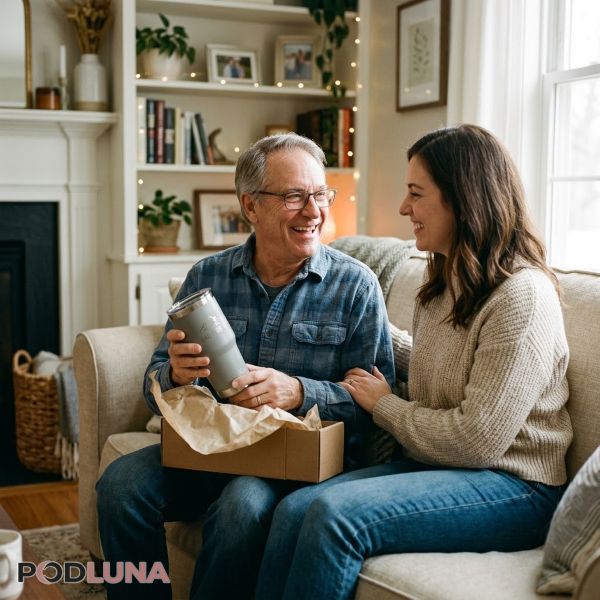
This is one of the most common gifting situations, and also the most misread. When Dad says he doesn’t need anything, the instinct is to search harder for something entirely new. That usually backfires, because it leads toward novelty purchases that get used once and then quietly disappear.
A more reliable approach follows three moves, roughly in this order: replace something worn out, upgrade something he already owns, or personalize a practical item he uses regularly. Start with something he uses so often that it’s already worn out. Replacing a favorite mug, hoodie, wallet, or everyday essential removes much of the guesswork, since you already know the item belongs in his routine. From there, an upgrade works the same way: a stained mug becomes an insulated one that helps his coffee stay warmer for longer. A stretched-out shirt becomes a comfortable, well-fitted one with a design that means something to him. A bare desk gets one small, personalized piece he’d actually want to look at.
You’re not adding to his pile of possessions; you’re improving what’s already there. That’s why replace, upgrade, and personalize works so well as a strategy for useful gifts for dads who say they want nothing. For more ideas built specifically around this scenario, see our guide to gifts for dads who want nothing.
Matching the Gift to His Personality
Personality is useful as a final filter, not a starting point. If Dad is hard on his clothes, durability probably matters more to him than novelty. If family memories mean a lot to him, a small personal detail may matter more than a flashy design. If he dislikes clutter, one high-use item is usually a safer bet than a bundle of smaller gifts. And if convenience drives most of his choices, prioritize something easy to carry, clean, and use without asking him to change his routine.
For the dad who seems to have everything, the replace, upgrade, and personalize approach covered above is really the whole playbook: the goal is improving what he already uses, not adding another item to what he owns.
Personalizing Apparel, Drinkware, and Home Decor Without Losing Utility

There’s a common assumption that personalized gifts are automatically decorative, like a photo frame or an engraved trophy meant to sit on a shelf rather than get used. That’s not the full picture. A personalized item can be just as functional as a plain one, provided it still meets the basics: it replaces something he uses, fits his routine, is comfortable, and is easy to maintain.
There’s actual research behind why this matters more than it might seem. Research highlighted by Yale School of Management, co-authored by marketing professor Nathan Novemsky and Ernest Baskin, found that gift-givers tend to prioritize desirable, exciting gifts, while recipients say they’d rather receive something practical. A related 2017 study in the Journal of Consumer Psychology by Julian Givi and Jeff Galak adds another layer: gift-givers choose sentimentally meaningful gifts far less often than recipients would actually prefer, likely because a generic, preference-matching item feels like a safer bet than a personalized one. Recipients tend to value the personalized option more than givers expect; givers just don’t trust their own judgment enough to choose it as often as they should.
That’s worth knowing before defaulting to the safest, most generic option. But it’s not a free pass to personalize everything either. Putting Dad’s name on something doesn’t automatically make it a good personalized gift. If he wouldn’t use the item without the personalization on it, the name probably isn’t solving the real problem, the item is. The rule of thumb: the smaller and simpler the personalization, the more an everyday, functional item can carry it. The bigger and more sentimental it gets, the more it belongs on something meant to be looked at rather than used daily.
| Personalization type | Best for | Risk of overdoing it |
|---|---|---|
| Initials | Minimalist or low-key dads | Very low |
| First name | Everyday drinkware and apparel | Low |
| Meaningful date | Sentimental dads, milestone gifts | Medium |
| Family phrase or inside joke | Casual, family-oriented dads | Medium |
| Photo | Highly sentimental dads | Higher |
| Long quote or paragraph | Display pieces, not everyday items | Higher |
This hierarchy is one of the more overlooked details behind good useful gifts for dads: personalization should scale with how often the item gets touched, not with how much emotion is behind the occasion. A useful rule for custom apparel in particular: don’t personalize around the occasion alone. “Best Dad Ever” might make sense on Father’s Day morning, but a shirt built around his actual hobby, a family nickname, or a phrase he genuinely uses has a much better chance of becoming part of his regular wardrobe.
For apparel, utility starts with fit before it starts with design. Check the size, fit, and fabric weight he actually wears day to day, not just what looks good in a product photo; a shirt that runs small or feels stiffer than what he’s used to won’t get worn no matter how good the design is. One of the easiest mistakes is choosing the personalization first and the wearable design second. A more reliable test: picture the design with the name removed. If it would still look like something he’d genuinely wear, the personalization is doing its job instead of carrying the whole gift.
For drinkware, think about how the piece will actually be used before choosing a design. A mug that lives on a desk can carry more visible personalization than a tumbler that gets thrown in a dishwasher every night or rides in a car’s cup holder. A name, initials, or a short meaningful date tend to hold up better over daily use and repeated washing than an elaborate design.
For home decor, prioritize a piece with an obvious place to live, on a desk or near a favorite chair, somewhere he actually spends time, rather than something that ends up in a box because there was never a clear spot for it. Decor is the one category here where more sentimental personalization, like a photo or a longer message, tends to work well, since the piece is meant to be looked at rather than handled daily.
| What Dad already uses | What to consider | Personalization that fits |
|---|---|---|
| Old, faded T-shirt | A better-fitting custom T-shirt | Hobby or family phrase |
| Morning coffee mug | An insulated mug or tumbler | Name or initials |
| Bare work desk | A small, functional desk piece | Meaningful family date |
| Worn-out hoodie | A comfortable replacement hoodie | A detail tied to his favorite hobby |
| Daily commute | Portable, spill-proof drinkware | Initials |
At Podluna, we focus on personalized apparel, custom drinkware, and home decor because those categories can add a personal detail without asking Dad to change what he already uses. The design matters, but the everyday habit comes first.
Matching the Gift to His Lifestyle, Not His Age

Age can provide context, but it should never be the main filter. A 35-year-old dad might prefer quiet evenings at home over anything trend-driven, while a 70-year-old dad might be the one in the family who wants the newest gadget. Those patterns can offer a rough starting point, dads earlier in their careers often lean toward commuting, work, and fitness gear, while dads deep in family life tend to gravitate toward home and hobbies, but they’re not rules. Pay attention to what he actually wears, carries, uses, and complains about; those clues are almost always more useful than a demographic label.
For a more detailed breakdown organized by daily habits rather than demographics, see how to choose gifts around his habits.
What to Spend on Useful Gifts for Dads
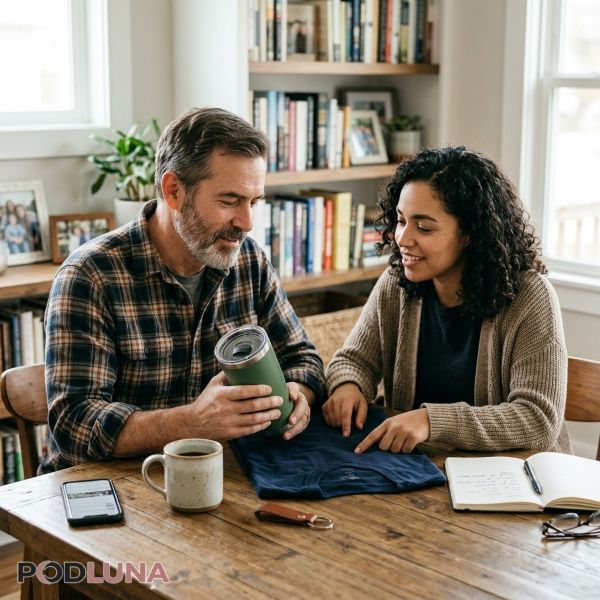
There’s no fixed “correct” number, but national data offers a useful reference point. According to the National Retail Federation’s 2026 Father’s Day survey, U.S. consumers planned to spend an average of $226.58 per person in 2026, up from $199.38 the year before, with 77% of consumers planning to celebrate Father’s Day. It’s worth being precise about what that figure means: it’s the total planned Father’s Day spending per consumer, covering cards, outings, clothing, and electronics along with gifts, not the average price of a single gift for Dad. Treat it as a general benchmark, not a target to hit.
| Budget range | Where to focus |
|---|---|
| Under $25 | Frequent-use essentials like drinkware or small accessories |
| $25–$50 | Better materials or added personalization |
| $50–$100 | A meaningful upgrade to something he already relies on |
| $100+ | A durable, premium item or a significant routine upgrade |
For a practical gift, frequency of use is often a better way to think about value than price alone. A lower-priced item he reaches for daily can end up delivering more real value than a pricier one he rarely touches.
Mistakes That Make a Gift End Up in a Drawer
Buying what you’d like isn’t the same as buying what he’d use. Personal taste and the recipient’s taste aren’t interchangeable, even between people who know each other well. Choosing novelty over utility is another common trap: funny or surprising gifts can be memorable for an afternoon, but they rarely earn repeat use. As the Yale-highlighted research noted above suggests, the gift that feels most fun to buy in the moment isn’t usually the one that gets the most use afterward.
Ignoring size, comfort, or maintenance is especially costly with apparel and drinkware, where the wrong fit or a fussy cleaning routine can sideline an otherwise solid idea. Adding to a pile he already has too much of, another basic mug, another plain T-shirt, turns into clutter unless the new version is a clear upgrade. Over-complicating the personalization tends to backfire too: a name or initials usually works better than an elaborate design, since personalization should make an item feel more relevant, not harder to use.
A Quick Gift Decision Checklist
Before you check out, run through this list:
- Does Dad already use something similar to this?
- How often will he realistically use it?
- Does it solve a problem he actually has?
- Does it fit into his existing routine?
- Is the size, fit, or comfort level right?
- Will it add clutter, or replace something?
- Could personalization make it more meaningful without complicating it?
- Would he pick this for himself, unprompted?
If you can’t finish the sentence “Dad will use this because ___” in one breath, it’s worth reconsidering before you buy.
Choose for His Routine, Not the Occasion

Father’s Day, birthdays, and Christmas are the reasons you’re shopping, not what should decide the gift itself. Once you know what Dad already uses, what needs replacing, and which parts of his day matter most to him, the occasion becomes secondary to his actual life. Explore more ideas built around this same logic in our roundup of family gift ideas.
The goal was never to find something Dad has never seen before. It’s to take something familiar and make it a little more useful, a little more comfortable, or a little more his, because someone paid attention and chose it specifically for him.
Questions to Ask Before Buying Dad a Useful Gift
What are the best useful gifts for dads? The best useful gifts for dads are usually practical items he already uses or would naturally add to his routine, like personalized apparel, drinkware, or functional home decor. The right choice depends less on the occasion than on what he already reaches for, what needs replacing, and what would make his day-to-day a little easier.
What makes a gift genuinely useful for Dad? A genuinely useful gift solves a real need, fits an existing routine, matches Dad’s preferences, and is easy enough to use regularly, not just something that looks practical sitting on a shelf.
What are useful personalized gifts for Dad? Useful personalized gifts usually start with something he already uses, such as a T-shirt, hoodie, mug, tumbler, or small piece of home decor. Add a name, initials, or a hobby-related detail only when it genuinely fits his everyday style and routine.
Should I replace something Dad already owns or buy something new? Start with a replacement or upgrade when you know an existing item is worn out or inconvenient. Choose something entirely new only when you can identify a clear, specific place for it in his routine.
Are personalized T-shirts good gifts for dads? They can be, especially when the design reflects something Dad already wears or enjoys. Check his usual size, preferred fit, and fabric weight, and picture whether the design would hold up as a shirt he’d wear beyond the day he opens it.
What are the best useful gifts for dads who have everything? Look for an everyday item he already uses, then replace it, upgrade it, or personalize it, rather than adding an unrelated new possession to what he owns.